
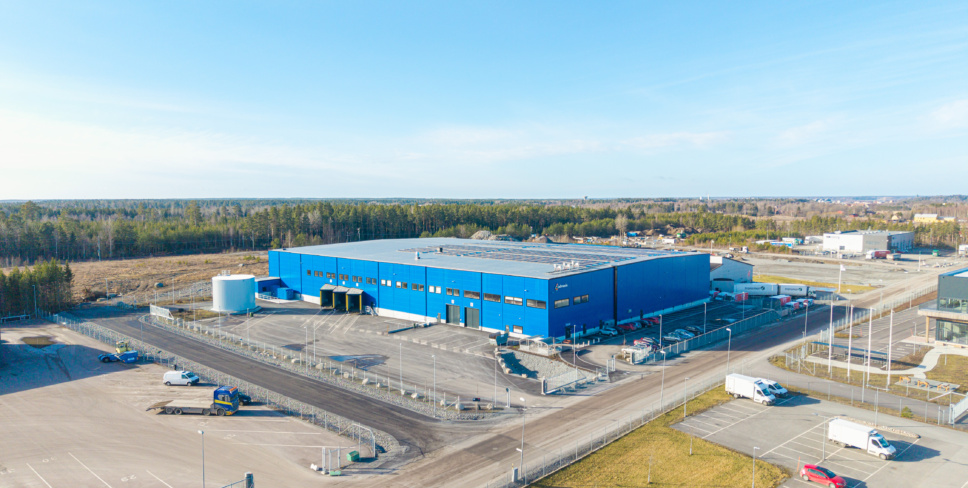
In 2025, construction of the property Stenvreten 8:37 was completed. Minimizing the climate footprint has been a guiding principle throughout the process. The building was certified in accordance with BREEAM-SE level Outstanding and NollCO2, with a final climate footprint (in line with the Swedish National Board of Housing, Building and Planning’s climate declaration instructions, including construction stages 7 and 8) of 212 kg CO2e per m² GFA (gross floor area).
Throughout the project, collaboration among all parties involved was crucial to the outcome. Through regular workshops and open discussions, we jointly solved challenges relating to material choices, logistics, and climate impact. For example, property owners, contractors, and specialists gathered to evaluate different solutions and quickly make joint decisions when new needs or opportunities arose. The engagement was evident, everyone contributed ideas and expertise to achieve the project’s high sustainability goals.
To measure and improve the building’s environmental performance, climate calculations were carried out during the project, meaning that the impact of different choices on CO2 emissions was assessed.
An important indicator for optimizing the building’s energy use is the primary energy number, which indicates how energy-efficient the building is; the lower the number, the less energy is required for operation, making the building more sustainable. In this project, the primary energy number is about 35 kWh per square meter per year, placing the building among the most energy-efficient in the country.
By using climate-improved concrete and optimizing the construction, we have managed to reduce CO2 emissions (the amount of carbon dioxide released during the building’s construction) by about 65% compared with traditional alternatives, that is, commonly used construction materials without specific environmental improvements. The climate impact from Stenvreten 8:37 is just over 40% lower than a reference building. This is partly due to the building’s steel frame consisting of 87% recycled material, which significantly reduces the environmental burden. We have also reused textile carpets and suspended ceilings in the office spaces, saving around eight tonnes of carbon dioxide.
In addition, we have installed geothermal heating combined with free cooling, and a solar panel system with an installed capacity of about 500 kWp. Together, these efforts have created an energy-efficient building with very low energy consumption. Sustainable transport solutions have been enabled through well-planned logistics, and we have placed strong emphasis on waste management and invested in ecosystem services such as stormwater management, meadow sowing, and habitats for insects.
In summary, thanks to strong commitment and close collaboration, the project has exceeded our ambitions. The building was completed on time, under budget, and with environmental results that set a new standard for future sustainable properties. We are proud to have created a workplace that demonstrates how cooperation and sustainable choices can make a real difference for both today’s and tomorrow’s society.